Thanks Glenn!

:o)
Not one drop of rain from any of these!


The Rose of Sharon are starting to bloom!

Wild strawberries:

Squash ( It's been so humid, the camera lens fogged up)!

She was a good girl - I will miss her!

My flock is getting smaller - will get more in the Spring to keep Benji happy!
:o)
How did they get all that coal into the tender???
A great film about old fashioned train sheds!
A train shed is a building adjacent to a station building where the tracks and platforms of a railway station are covered by a roof.
It is also known as an overall roof. Its primary purpose is to store
and protect from the elements train cars not in use, The first train
shed was built in 1830 at Liverpool's Crown Street Station. The biggest
train sheds were often built as an arch of glass and iron, while the
smaller were built as normal pitched roofs. The train shed with the
biggest single span ever built was that at the second Philadelphia Broad
Street Station, built in 1891.
Enjoy!
:o)
... alive!
Don't know for how much longer though. :o(

She's very weak and eats very little amounts of feed.
She does eat grapes that I cut up in small pieces for her.
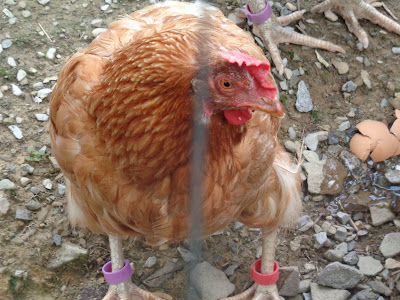
If she was in pain, I would have to put her down. So sad....
I might have to find Benji a new home - He's going to need more than three hens

Our resident crows - I wonder what they find so interesting in the grass!

The damn deer ate all the tops of the lilies.

Bet we are going to get a hard winter this year. The hickory nuts are falling off the trees alread and the squirrels are going crazy collecting and burring them!

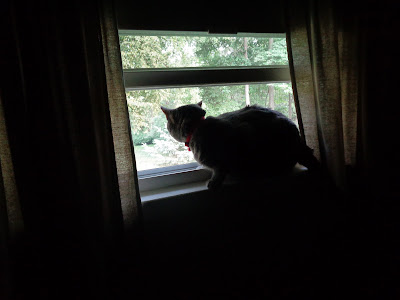
Kitty-Kat just LOVES watching them from the window!
:o)
Frogfish Facts
| Frogfish is a type of angelfish. There are 45 species of frogfish that can be found in the tropical and subtropical waters near the coasts of Africa, Asia, Australia and North America. Frogfish usually inhabits coral reefs, on a depth of 330 feet. Frogfish is a bottom-dweller that spends its life on the rocky sea floor. Despite accelerated habitat destruction and pollution of the sea, wild population of frogfish is still large and stable. |
| Interesting Frogfish Facts: |
|---|
| Frogfish can reach 1/8 to 22 inches in length, depending on the species. |
| Color of the body depends on the habitat. Frogfish can be white, yellow, beige, pink, green or black colored. It is able to quickly change the color of the body to blend with its environment. |
| Frogfish does not have scales. Unusual shape of the body and spines (or bumps) on the surface create impression of the sponge. |
| Frogfish has short, stocky body with upward pointed mouth and rounded dorsal fins and tail. |
| Frogfish is a carnivore (meat-eater). Its diet is based on the fish and crustaceans. |
| First spine of dorsal fin is modified into rod with twig, feather or worm-like lure called "esca" on the top. Frogfish wriggles the lure in front of the head to attract the prey. Lure can be regenerated in the case of damage. |
| Frogfish is an ambush predator which hunts the prey using the element of surprise. Once the prey is close enough, frogfish swallows it in a blink of an eye (attack lasts 6 milliseconds). |
| Frogfish can swallow the prey that is 2 times bigger than the fish itself thanks to ability to expand the mouth 12 times of its normal size. Frogfish does not have teeth and it swallows the prey in one piece. |
| Frogfish rarely swims. It usually walks on the sea floor using the modified pectoral fins. |
| Natural enemies of frogfish are large species of frogfish and moray eel. |
| Frogfish can inflate the body to startle the predators. |
| Frogfish is a solitary creature. It can be found with other frogfish only during the mating season. Fertilization takes place in the water (where males and females release their reproductive cells). Female produces 40.000 to 180.000 per season. |
| Eggs are laid in the mucus on the ocean floor. They are often called "veil" or "egg raft" due to ribbon-like shape of the mass of eggs and ability to float thanks to ocean currents. Fry emerge from the eggs 2 to 5 days after fertilization. Young fish are often colored like the poisonous sea slugs or flatworms (to ensure protection against predators). |
| Some species of frogfish do not show parental care, while others guard the eggs until they hatch. Some males carry eggs in between the hairs, bumps and other structures on the body. |
| Frogfish can survive up to 20 years in the wild. |


:o)

